Your business can't grow faster than you can answer questions.
It has a name: The Bottleneck. Every decision queues behind you, and the business moves at the speed of your calendar. Join the founding cohort of the AI that installs leadership capability into your operating model, so growth stops depending on you.
Founding-cohort pricing locked for life · No spam, ever · Already a member? Sign in
- Founding price, locked for life
- First in line when access opens
- Help shape what we build
Refer leaders, earn founding rewards
Insider1 referral
An instant private note from Stuart · 1 month of CapabilityAI Professional free when we open
Pioneer3 referrals
3 months of CapabilityAI Professional free at opening
Founding Member5 referrals
Permanent founding badge · 6 months of CapabilityAI Professional · Direct input on the product roadmap
Architect's Circle10 referrals
12 months of CapabilityAI Professional · Private group session with Stuart · Your name in the launch credits
Trusted By Leaders At
















If you went off-grid for two weeks, would the business grow, or hold its breath?
Most founders already know the answer. That answer is the bottleneck, measured.
75%
of founders and CEOs have a low instinct for delegation, the bottleneck, measured in one number. The ones who do delegate well generate 33% more revenue.
The cost is quiet but constant. Days lost waiting on your sign-off. Good people who stop deciding because deciding became your job. Growth you've already paid for but can't collect, because the work can't move without you.
You didn't build a bottleneck on purpose. Capability was simply never installed into the operating model. Every decision routes back to you because nothing was ever designed to route anywhere else.
The shift is from being the operator to being the architect, building the systems, judgement, and decision-making capability into your team so the business can grow beyond the limits of your own day.
An AI coach that knows you
Built on 25 years of real leadership work and your own diagnostic, it remembers your goals, team, and blind spots, so judgement stops being something only you can supply.
Capability installed, not delivered
A workshop hands you a binder; the bottleneck stays. This installs decision rights, judgement, and operating rhythm into how your team works, so growth stops routing through you.
It holds you accountable
Proactive nudges and check-ins between sessions keep the new operating rhythm in place, follow-through, not answers on demand.
Fifteen years of growth, and the first investment in the people leading it
A founder on the moment they stopped scaling on instinct alone, and what changed once leadership stopped being the one thing they'd never funded.
Proof
In their words
Real leaders Stuart has worked with, across telco, financial services, healthcare, supply chain and high-growth firms.
A natural leader
"Stuart is a natural leader with an extraordinary ability to drive initiatives, motivate, develop and empower others by creating a safe environment where they can be themselves and their opinions matter. He directed one of the top five key initiatives at Optus, an exceptional job on a significantly large, complex and global digital transformation."
Darren Clarke
Chief Operating Officer · The Yield Technology Solutions
Calm, collected and in control
"Stuart oversaw a major RFP for Optus Wholesale, calm, collected and professional throughout, and he kept the panel on the original timelines with excellent control of the vendors the whole way through. I'd happily work with him again on any initiative."
Matt Pankhurst
Director, Mobile Fleet Products · Optus
Gets things done
"Stuart led a large and complex digital transformation our companies delivered together. He always looked for the best solutions even when there were challenges, and went out of his way to build trust, which was key to getting things done. I'd welcome working with Stuart again."
Keith Meier
Chief Financial Officer · Assurant
Navigates complex change
"Stuart and I partnered on an innovative digital program of change to redesign the repair and upgrade experience for our customers. His professionalism, drive and determination are second to none, and he navigates complex and ambiguous change landscapes with ease."
George Colinard
National Operations Director · JnJ Supply Chain
Capability that outlasts
"A multi-year partnership that rebuilt how our entire leadership layer operates. The capability outlasted my tenure."
CEO
Enterprise telecommunications · Australia
One architecture at scale
"Across multiple business units he gave us one leadership architecture and a common language. Transformational at scale."
Group Managing Director
Diversified holdings · Singapore
What the research shows
Founder-led companies routinely stall at scale because decision authority never decentralises: research on scaling organisations finds the single biggest constraint on growth past ~50 people is the leadership team's capacity to delegate consequential decisions, not market or capital.
Ask yourself
If you were unreachable for two weeks, how many decisions would simply pause until you returned?
Mobile App
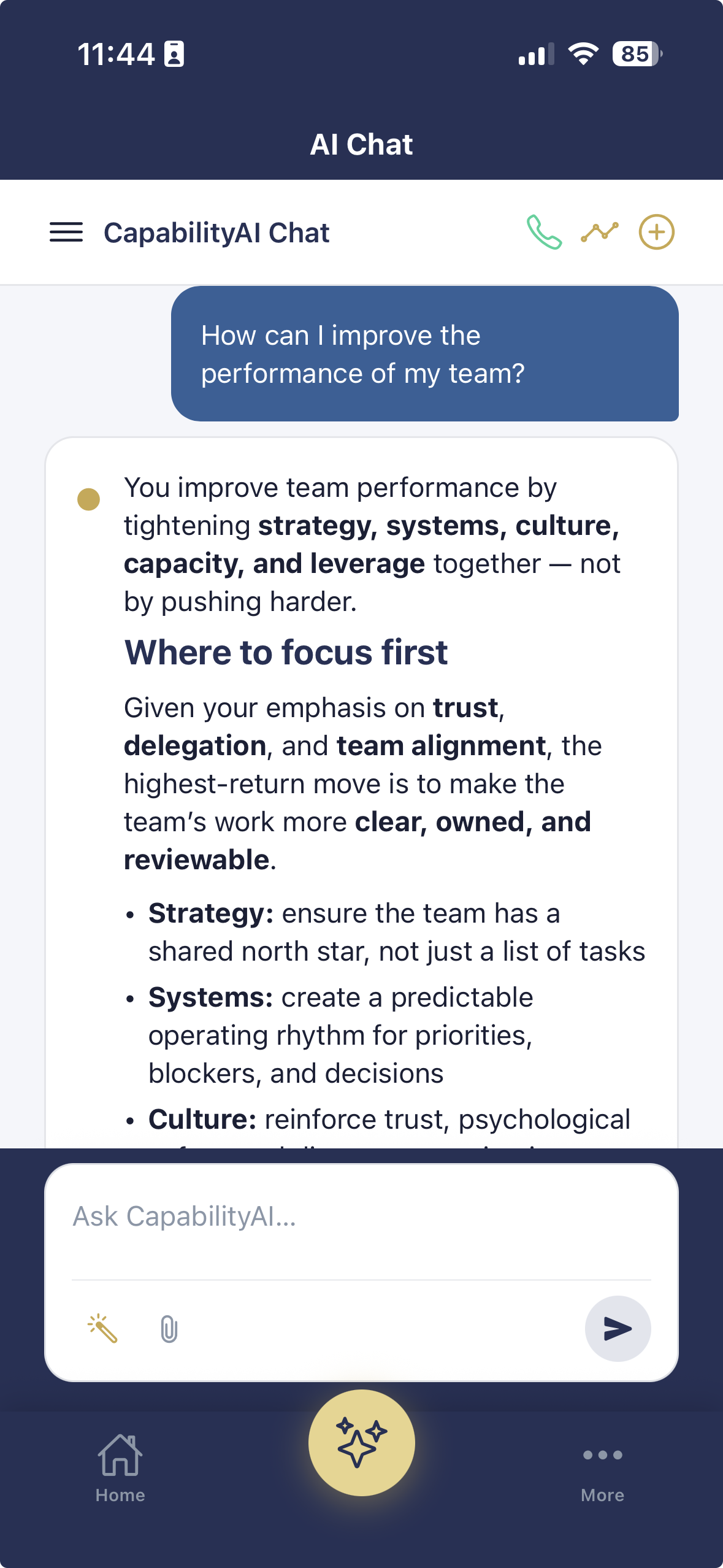
Your AI coach for the decisions only you used to make.
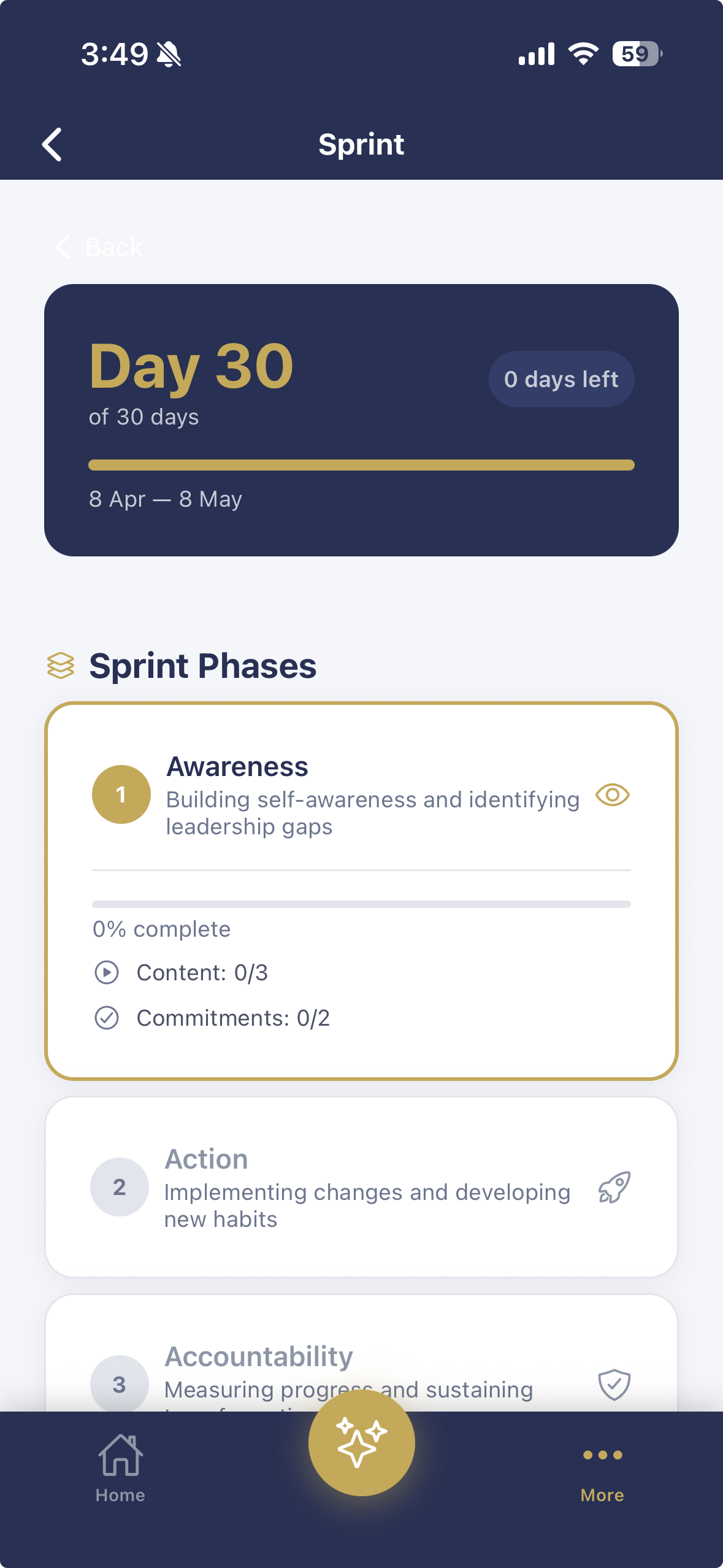
Your AI leadership coach, programs, diagnostics, and sprint tracker, always in your pocket.
- AI coaching conversations, wherever you are
- Leadership debrief and reflection after every session
- Full program access with daily sprint tracking
- Voice sessions with your AI leadership coach, on plans that include them
Proof
Founders who got out of the decision queue
Real engagements where capability was installed into the operating model, and growth stopped depending on one person.
Scale-up · founder-led leadership team
Confidential engagementConstraint
Every decision still ran through the founder, the leadership team could execute, but couldn't decide without them, and the business had quietly capped its own growth at the founder's bandwidth.
Intervention
Installed clear decision rights and a structured operating rhythm so the leadership team could resolve issues without escalating everything to the founder, freeing the founder to lead as CEO rather than firefight as operator.
Outcomes
- Founder time spent on operational issues decreased by 45% within 6 months
- Decision turnaround time on key issues reduced by 52% in 3 months
- Engagement scores for the leadership team improved by 18 points over 9 months
Assurant: Fortune 500
Execution Cadence SystemConstraint
A Fortune 500 insurance and device-protection company wanted to transform its device service offering, building a device-return capability and lifting Net Promoter Score through new digital customer interactions. The initiative was a top-5 CEO priority.
Intervention
Led the supply chain transformation and new product development program end-to-end, pairing structural change with the leadership cadence needed to keep a CEO-priority initiative on track.
Outcomes
- A top-5 CEO priority program delivered
- A new device-return capability built from the ground up
- Improved customer NPS through redesigned digital interactions
“Stuart led a large and complex digital transformation project... he always went out of his way to promote a positive relationship which creates a lot of trust and was key to get things done.”
Optus: customer personalisation
Execution Cadence SystemConstraint
Customers increasingly expected personalised, contextual engagement, but the organisation had no Next Best Action capability across channels, leaving churn and market-share growth on the table.
Intervention
Delivered a Next Best Action model across every customer type and channel, connecting insight-led decisioning to real-time, personalised dialogue.
Outcomes
- Reduced customer churn by 30%
- Delivered over 20% in incremental sales, including $200M in incremental sales from the new omnichannel architecture
- Increased Net Promoter Score by 20%
“I have absolute trust that he will lead his team to keep the program on track... Integrity is a strength and he is not afraid to challenge anyone where he sees a more efficient way of tackling a problem.”
Optus: sponsorship coaching
Execution Cadence SystemConstraint
A major transformation program was exposed to real sponsorship risk, corporate and political barriers, conflicting KPIs between departments, and a trust gap between sponsors and delivery teams.
Intervention
Coached the program's sponsors directly, giving them hands-on, practical tools to give their teams real authority and hold the line through political and cross-departmental friction.
Outcomes
- Sponsors equipped to trust delivery teams with real decisions through organisational friction
- Transformation programs kept moving despite conflicting departmental priorities
- A repeatable sponsorship model, not one-off firefighting
“Stuart is a solid and diligent Program Manager... builds high performance teams and ensures that everyone is aware of the progress, status and risks of the programs.”
Frequently asked questions
Not sure this is you? See which one fits