The Being Layer
SA-EPSA: Executive Presence & Strengths
"Who is this leader, at their core?"
Before behaviour, before the team, before the system, there is who the leader is. SA-EPSA maps a leader's identity, presence, and strengths across twelve dimensions, so development starts from the truth rather than a job title.
Why it matters
Development that starts from a job title starts from a guess
The most expensive leadership mistakes trace back to a leader operating from an inaccurate picture of themselves, over-indexing on a strength, blind to how their presence actually lands. Objective assessment is the highest-ROI development method there is precisely because it replaces that guesswork with a calibrated read. SA-EPSA gives a leader, and their coach, the truthful starting point that makes everything after it work.
The cost of not knowing
- Coaching spend that misses, because it's aimed at the wrong gap
- High-potentials promoted on presence, not substance, then struggling
- Leaders unaware of the one strength they're over-relying on
What knowing gives you
- ✓Coaching aimed at the real gap, so the spend actually moves the needle
- ✓A calibrated read on presence and strengths, not a self-perception guess
- ✓The one over-relied-on strength named before it becomes a derailer
The method
Not another assessment. A process that creates change.
"Most assessments end at the debrief. This one starts there."
Start with context
We begin with what you're actually facing, the decision, the pressure, the moment, not a score in a vacuum.
A calibrated read
An objective, benchmarked measure of how leadership shows up under real conditions, not a self-perception snapshot.
Benchmark the read
Your profile is scored against a calibrated cohort, so 'distinctive' and 'developing' mean something, not just a number.
In your language
Scored against Stuart's 5D model, one architecture across leader, team, and organisation, not a generic off-the-shelf list.
End in action
Every report resolves into prioritised, routed next moves and a re-measure loop, so the insight drives change, not a drawer.
One architecture, four altitudes
The Assessment Suite
Being → Doing → Team → System. Four assessments, one continuous architecture, all grounded in the 5D Leadership Architecture.
Being · you are here
SA-EPSA
Who the leader is
Doing
Leadership 360
How the leader behaves
Team
Team Effectiveness
How the team works
System
Organisational Maturity
What the organisation is
What it measures
The dimensions
Identity
Values, integrity, inner belief, and authenticity, who you are at your core.
Vision
How clearly you see and shape the future, and turn it into momentum.
Influence
How you communicate, connect, and carry yourself to move others.
Relational Impact
The experience others have with you, how you include, support, and steady people.
Who it's for
Built for leaders who are done with generic
Senior leaders who want an honest read on their presence and strengths
High-potentials being prepared for bigger roles
Executives entering coaching who want a grounded starting point
What you get
A report that actually lands
Twelve-dimension identity profile
Scored against a calibrated benchmark, grouped into four strategic domains.
Distinctive strengths
The dimensions where you stand out, and how to lean on them.
Development priorities
Where growth will most change your leadership, framed against Fortune 500 executive-capability tiers.
Narrative, not just numbers
A de-identified, magazine-grade written report, not a data dump.
See it for yourself
A real page from the report
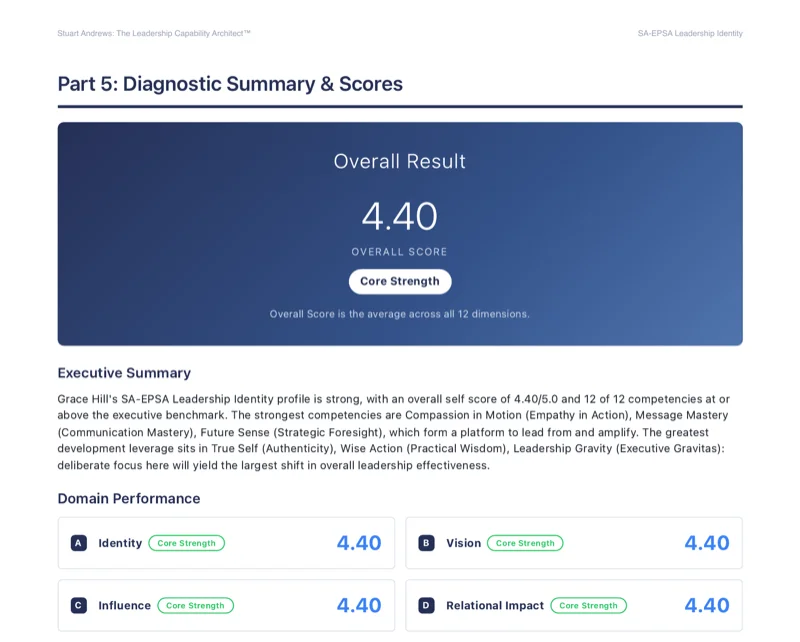
The Diagnostic Summary from a real (de-identified) SA-EPSA report.
The evidence
Objective assessment is the highest-ROI development method there is
Grounded in Stuart Andrews' 25 years of practice and his book The Leadership Shift, and backed by DDI's Global Leadership Forecast 2025, the largest leadership study of its kind.
of companies report strong ROI from objective leadership assessments, outpacing every other development method.
DDI Global Leadership Forecast 2025more likely to be a top-10% financial performer when assessment is paired with coaching.
DDI Global Leadership Forecast 2025of top financial performers use assessments, versus 46% of organisations overall.
DDI Global Leadership Forecast 2025Proof, not promises
How you'll know it worked
SA-EPSA is the baseline the rest of the development process is measured against. Re-assess after a development cycle and the movement in each dimension is your evidence of growth, the same pre-then-post logic that lets leadership programmes survive board scrutiny.
Signals to track
- ✓Measurable shift in target dimensions on re-assessment
- ✓Development effort concentrated where it changes leadership most
- ✓A shared language between leader and coach from day one
How this is different
Not another off-the-shelf assessment
How it works
Three steps to the truth
Complete the self-assessment
A focused set of items across the twelve dimensions of executive identity.
Your profile is scored
Benchmarked against a calibrated cohort, grouped into four domains.
You get your report
A designed report plus the option to explore it with your CapabilityAI coach.
Frequently asked questions
Start from the truth of who you are
Add SA-EPSA to your organisation's assessment suite.