The Team Layer
The Team Effectiveness Audit
"How does this team actually work together, and where does it break?"
Most team tools tell you the team is 'not aligned' and leave you there. This one shows you exactly which stage of team health is holding you back, and which kind of work your team has no one to carry, in the same 5D architecture behind everything else.
Why it matters
A team that can't be honest is a cost you're already paying
Most executive teams don't fail on strategy, they fail on the conversations they avoid, the decisions no one truly commits to, and the roles no one is energised to carry. That friction is expensive long before anyone names it: it shows up as slow decisions, quiet turnover, and initiatives that stall in the last 10%. The Team Effectiveness Audit makes the invisible visible, so you can fix the constraint instead of working around it.
The cost of not knowing
- Decisions that get re-litigated in hallways because commitment was never real
- High performers quietly carrying underperformers, until they leave
- Work that stalls in a phase no one on the team is energised to own
What knowing gives you
- ✓The fix-first constraint named, so you work the bottleneck, not the symptom
- ✓Every blank in the energy grid made visible before it stalls the next initiative
- ✓One honest, shared map the whole team can act on together
The method
Not another assessment. A process that creates change.
"Most assessments end at the debrief. This one starts there."
Start with context
We begin with what you're actually facing, the decision, the pressure, the moment, not a score in a vacuum.
A calibrated read
An objective, benchmarked measure of how leadership shows up under real conditions, not a self-perception snapshot.
Triangulate the view
Your self-rating meets multiple informant views, so the picture converges on reality instead of resting on one opinion.
In your language
Scored against Stuart's 5D model, one architecture across leader, team, and organisation, not a generic off-the-shelf list.
End in action
Every report resolves into prioritised, routed next moves and a re-measure loop, so the insight drives change, not a drawer.
One architecture, four altitudes
The Assessment Suite
Being → Doing → Team → System. Four assessments, one continuous architecture, all grounded in the 5D Leadership Architecture.
Being
SA-EPSA
Who the leader is
Doing
Leadership 360
How the leader behaves
Team · you are here
Team Effectiveness
How the team works
System
Organisational Maturity
What the organisation is
What it measures
A three-layer model
Can this team function? Five stages built on the 5D lifecycle (Discover → Desire → Define → Deliver → Drive), each one resting on the one before it.
Shared Reality
Whether this team sees and says the same truth, including the bad news.
Collective Ambition
Whether this team wants the same outcome more than individual wins.
Decision Clarity
Whether decisions are argued properly, closed clearly, and genuinely owned.
Execution Discipline
Whether this team follows through peer to peer, without the leader policing.
Compounding Momentum
Whether this team learns, improves, and makes wins repeatable.
Who it's for
Built for leaders who are done with generic
Executive and senior leadership teams that look high-performing but stall on the things that matter
New leaders inheriting a team and needing an honest map of its dynamics, fast
Teams post-restructure or post-merger where trust and roles have quietly shifted
What you get
A report that actually lands
Team Health Arc profile
All five stages scored, with the earliest weak stage flagged as the fix-first constraint, because everything above rests on it.
Energy coverage map
Where your team is strong, thin, or blank across Design·Embed·Scale, the 'this is why work stalls here' view.
Strategy to Execution scoring
Whether the team owns its strategy and can actually orchestrate it, scored against Stuart's own transformation framework.
Perception gap
Where the leader's view of the team and the team's lived reality diverge, the blind spots that matter most.
Routed next moves
Development steps tied back to the 5D pillars and coaching library, not generic tips.
See it for yourself
A real page from the report
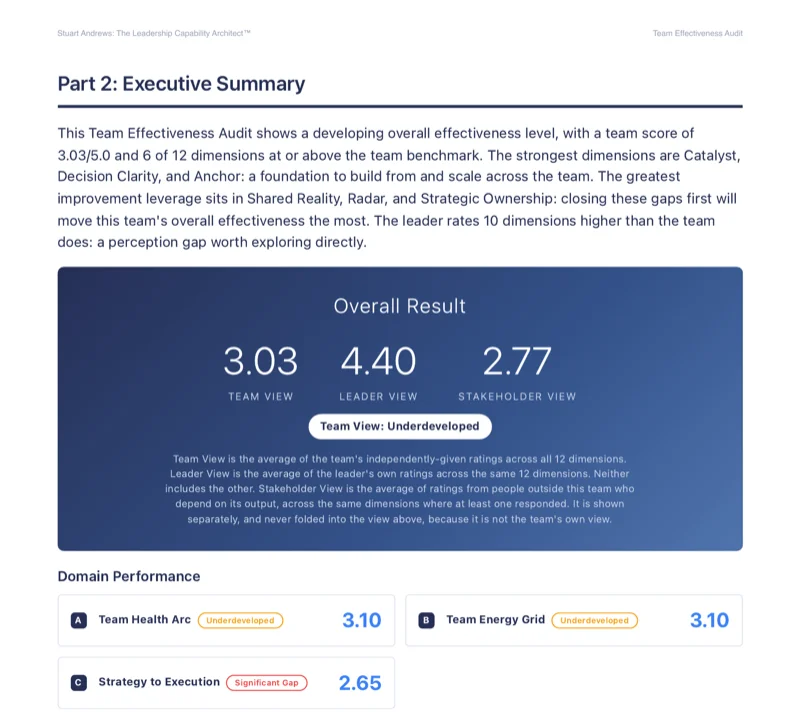
The Executive Summary from a real (de-identified) Team Effectiveness report.
The evidence
Objective assessment is the highest-ROI development method there is
Grounded in Stuart Andrews' 25 years of practice and his book The Leadership Shift, and backed by DDI's Global Leadership Forecast 2025, the largest leadership study of its kind.
of companies report strong ROI from objective leadership assessments, outpacing every other development method.
DDI Global Leadership Forecast 2025more likely to be a top-10% financial performer when assessment is paired with coaching.
DDI Global Leadership Forecast 2025of top financial performers use assessments, versus 46% of organisations overall.
DDI Global Leadership Forecast 2025Proof, not promises
How you'll know it worked
This isn't a one-off snapshot. Re-run the audit after an intervention and the numbers move, or they don't, and you adjust. The self-vs-team perception gap is the sharpest early signal: when it narrows, trust and candour are genuinely improving, not just being talked about.
Signals to track
- ✓The weakest health stage lifts on re-assessment 6-12 months later
- ✓The self-vs-team perception gap narrows, leaders and teams converge on reality
- ✓Blank cells in the energy grid get covered as roles are rebalanced or hired for
How this is different
Not another off-the-shelf assessment
How it works
Three steps to the truth
Each member rates the team
The leader self-rates; the team rates the same statements. 72 behavioural, executive-grade items, no filler.
The three layers are scored
Health Arc + Energy Grid + Strategy to Execution, with self-vs-team perception gaps computed automatically.
The team gets its map
A designed report + live dashboard showing exactly where to intervene first.
Frequently asked questions
See how your team really works
Add the Team Effectiveness Audit to your organisation's assessment suite.