The System Layer
The Organisational Maturity Audit
"What is this organisation actually capable of, as a system?"
Leaders and teams sit inside a system. The Organisational Maturity Audit is a multi-informant read of that system across eight dimensions, from leadership and culture to measurement, process, and AI readiness, where the gap between how leaders see it and how staff live it is the insight.
Why it matters
Leaders and staff are rarely looking at the same organisation
Every scaling organisation hits a point where the leadership team's picture of how things work and the reality the staff live diverge, and that gap is exactly where capital gets misallocated. The Organisational Maturity Audit measures the whole system across eight dimensions and surfaces the leader-vs-staff perception gap, so investment goes to the constraint that's actually holding the organisation back, not the one that's most visible from the top.
The cost of not knowing
- Investment aimed at the wrong constraint because the top can't see the floor
- Process and measurement debt that quietly caps growth as you scale
- AI and future-readiness gaps that widen while attention is elsewhere
What knowing gives you
- ✓Capital aimed at the real constraint, not the one that's loudest from the top
- ✓The leader-vs-staff gap made visible, the honest signal of where maturity sits
- ✓A year-on-year maturity baseline you can re-measure progress against
The method
Not another assessment. A process that creates change.
"Most assessments end at the debrief. This one starts there."
Start with context
We begin with what you're actually facing, the decision, the pressure, the moment, not a score in a vacuum.
A calibrated read
An objective, benchmarked measure of how leadership shows up under real conditions, not a self-perception snapshot.
Triangulate the view
Your self-rating meets multiple informant views, so the picture converges on reality instead of resting on one opinion.
In your language
Scored against Stuart's 5D model, one architecture across leader, team, and organisation, not a generic off-the-shelf list.
End in action
Every report resolves into prioritised, routed next moves and a re-measure loop, so the insight drives change, not a drawer.
One architecture, four altitudes
The Assessment Suite
Being → Doing → Team → System. Four assessments, one continuous architecture, all grounded in the 5D Leadership Architecture.
Being
SA-EPSA
Who the leader is
Doing
Leadership 360
How the leader behaves
Team
Team Effectiveness
How the team works
System · you are here
Organisational Maturity
What the organisation is
What it measures
The dimensions
People & Culture
How leadership and culture create trust, accountability, and shared ownership.
Operating System
How the organisation measures, documents, and tools the way work gets done.
Capability & Results
How training builds capability, and what that capability produces.
Future Readiness
How ready the organisation is to make good decisions and build AI-augmented capability.
Who it's for
Built for leaders who are done with generic
Executives who want an honest, whole-system read, not a survey
Organisations scaling and feeling the strain on process and measurement
Leadership teams aligning on where to invest to raise maturity
What you get
A report that actually lands
Eight-dimension maturity profile
Each dimension scored 1-5 as a maturity level, grouped into four strategic domains.
Leader-vs-staff perception gap
Where leadership rates the organisation rosier than the people inside it, the honest signal.
Rater perception heatmap
Every dimension broken down by who is rating it, so divergence is visible at a glance.
Priority matrix
Score vs perception gap, sorted into blind spots, verified strengths, and shared priorities.
See it for yourself
A real page from the report
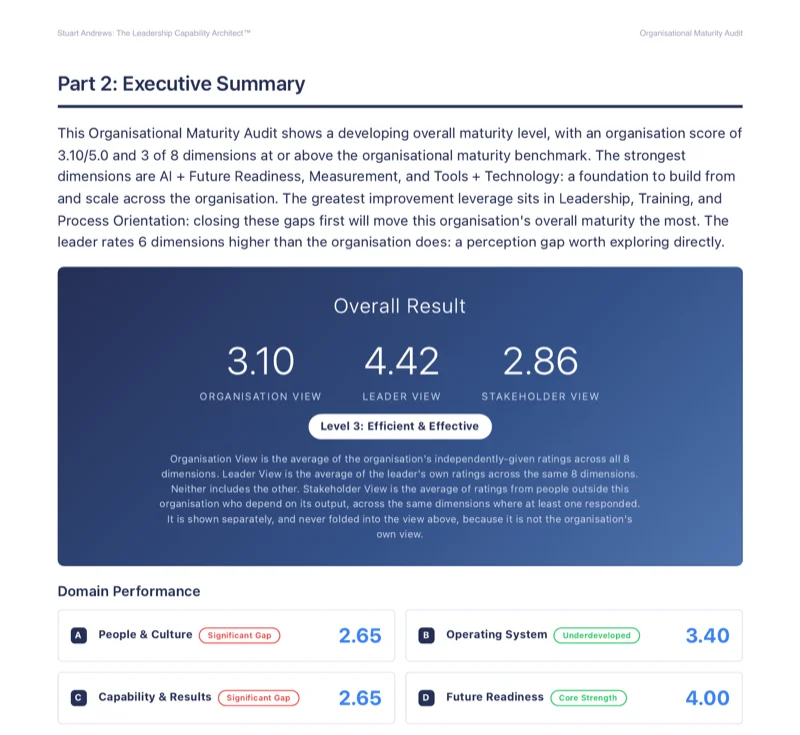
The Executive Summary from a real (de-identified) Organisational Maturity report.
The evidence
Objective assessment is the highest-ROI development method there is
Grounded in Stuart Andrews' 25 years of practice and his book The Leadership Shift, and backed by DDI's Global Leadership Forecast 2025, the largest leadership study of its kind.
of companies report strong ROI from objective leadership assessments, outpacing every other development method.
DDI Global Leadership Forecast 2025more likely to be a top-10% financial performer when assessment is paired with coaching.
DDI Global Leadership Forecast 2025of top financial performers use assessments, versus 46% of organisations overall.
DDI Global Leadership Forecast 2025Proof, not promises
How you'll know it worked
Maturity is a level you move up. Re-audit annually and each dimension's score is your evidence of progress, and as the leader-vs-staff perception gap closes, you know the improvements are real on the floor, not just on the org chart.
Signals to track
- ✓Dimension maturity levels rise year on year
- ✓The leader-vs-staff perception gap narrows across dimensions
- ✓Investment lands on the blind-spot constraint, not the visible one
How this is different
Not another off-the-shelf assessment
How it works
Three steps to the truth
Leaders and staff rate the system
The same statements about the organisation, answered across the informant base.
Maturity is scored by dimension
Each of the eight dimensions reads directly as a 1-5 maturity level.
You get the audit
A designed report with heatmap, priority matrix, and a live team-comparison dashboard.
Frequently asked questions
See your organisation as a system
Add the Organisational Maturity Audit to your organisation's assessment suite.