Growth doesn't kill companies. Complexity does, and nobody tells you that when the phone starts ringing off the hook. Complexity arrives disguised as success: new clients, bigger contracts, a team that's finally big enough to matter. I've watched this pattern from the inside, running teams and advising founders through exactly this stage, and I'll say it plainly: the thing that takes down a fast-growing business is almost never the market. It's the business itself, quietly buckling under its own weight while everyone celebrates the top-line number.
You don't get a warning shot. You get a slow leak. Meetings that used to take twenty minutes now take an hour, because five more people need to be in the room to make the same decision. A customer request that used to be answered same-day now bounces between three departments before anyone owns it. None of this shows up on a P&L until it's already expensive. That's the trap: the silent killer of growth isn't a single bad decision. It's dozens of small ones, compounding, invisible, until the business that felt unstoppable six months ago suddenly feels like it's wading through wet cement.
I've seen the same story play out with founders who swore it wouldn't happen to them. They'd read the case studies, they knew the warning signs on paper, and they still walked straight into it, because the warning signs don't look like warning signs while revenue is climbing. A backlog that used to be a mild irritation becomes a permanent fixture. A chat channel that used to have three people in it now has thirty, and nobody remembers who's actually accountable for the decision it exists to make. None of that reads as crisis. It reads as busy. That's the disguise.
Traditional Scaling: Brute Force Solutions
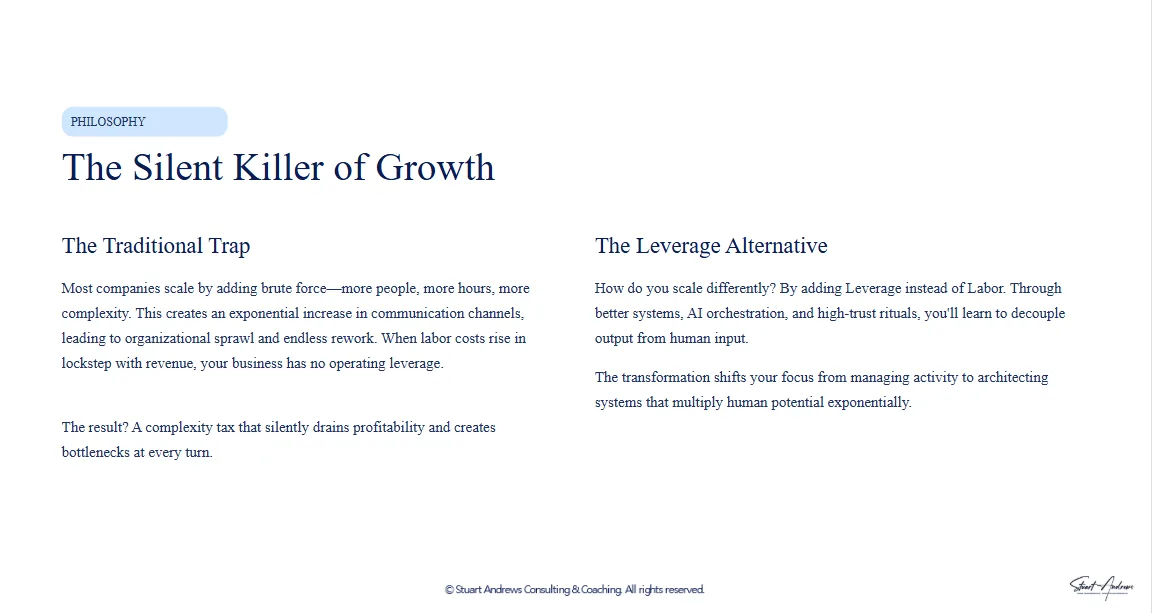
When demand outpaces capacity, the instinct is always the same: hire. Add hours. Throw bodies at the bottleneck. I understand the appeal: it's fast, it's visible, and it feels like progress. Boards like it. Investors like it. For a while, it even works. But brute-force scaling has a hidden clock running underneath it, and most leaders don't notice until the clock runs out.
Hiring is not the same as scaling: that's the reframe I give clients. Hiring adds capacity. Scaling multiplies output without multiplying headcount at the same rate. Confuse the two and you end up with a bigger, slower, more expensive version of the same organisation, not a stronger one. The excitement of expanding the team, buying more tools, and saying yes to every new customer is real. It's also exactly how businesses talk themselves into a structure they can't afford to run twelve months later.
There's a reason brute-force scaling is the default choice rather than a considered one: it requires no redesign. You don't have to rethink how decisions get made, who owns what, or where the handoffs sit: you just add another person into the existing shape of the organisation and hope the shape holds. It rarely does. The org chart that worked at twenty people starts creaking at sixty, not because the people are worse, but because the chart was never built to carry that much coordination weight in the first place.
The Hidden Costs of Complexity
What doesn't show up on the dashboard is the exponential growth in coordination cost. Every person you add doesn't just add their own output: they add a new set of communication lines, handoffs, and potential points of failure. Organisational sprawl isn't a side effect of growth. It's a direct, predictable consequence of adding people without redesigning how work moves between them.
The instinctive fix (hire more people to manage the people you already hired) is where most companies lose the plot entirely. When labour cost grows in lockstep with revenue, you haven't scaled. You've traded one constraint for another and called it progress. Cash flow tightens. Margins compress. And the business that looked unstoppable on the outside starts running on fumes on the inside.
I call this the complexity tax. It's not a line item (nobody budgets for it, nobody names it in the board deck), but it's real, it's compounding, and it's the single most reliable profitability killer I see in growth-stage companies. It shows up as rework nobody flagged, decisions that get made twice by two different teams, and good people quietly burning out trying to hold together a structure that was never actually designed, just accumulated.
There's also a trust cost that rarely gets named. As teams grow past the size where everyone can track what everyone else is doing, leaders instinctively respond by adding checkpoints: another approval, another status meeting, another sign-off. Each one feels reasonable in isolation. Stacked together, they form a system where nothing moves without someone senior clearing it, which means the senior people become the bottleneck for everything, which is the exact opposite of what hiring was supposed to solve.
I've also noticed the complexity tax has a compounding rhythm to it: it doesn't arrive as a single bill, it arrives as a subscription. The first quarter it costs you a bit of speed. The second quarter it costs you a good hire who got tired of handling internal politics to get anything shipped. By the third or fourth quarter it's costing you customers, because the same sprawl that slows internal decisions eventually slows the decisions that touch the people paying you. Leaders who catch it in quarter one fix a process problem. Leaders who catch it in quarter four are fixing a culture problem, and culture problems take years, not sprints, to unwind.
How I evaluate a growth-stage business
- Coordination cost, not headcount: I don't ask how many people you have. Count the approvals required to ship a decision. If the answer keeps rising faster than revenue, you're accumulating debt, not capability.
- Who owns the handoff: Most breakdowns don't happen inside a team: they happen in the gap between teams. I map every handoff before I look at any individual's performance.
- Systems before people: If the fix to every new problem is 'hire someone,' the system is broken, not the headcount. I look for where a process, not a person, should absorb the next unit of growth.
- Trust as infrastructure: Low-trust teams route everything through a manager, which caps throughput at one person's attention span. High-trust teams route decisions to whoever is closest to the information. That's a structural choice, not a personality trait.
- What breaks first under 2x load: Have leaders imagine doubling revenue with no new hires. Whatever breaks first in that thought experiment is the actual constraint, and it's rarely the one they're currently solving for.
Using Systems for Sustainable Growth
The alternative to hiring your way through complexity isn't 'do more with less.' It's decoupling output from headcount. That means building systems, decision rights, and rituals sturdy enough that adding a customer doesn't automatically require adding a person. Some hiring will always be necessary: I'm not arguing for a headcount freeze. I'm arguing that hiring should be the last lever you pull, not the first.
In practice this looks like three things working together: processes that don't depend on any one person's memory, thoughtful use of AI and automation to absorb repeatable coordination work, and high-trust rituals that let decisions get made at the point of information rather than bouncing up a chain of command. None of these are exotic. What's rare is doing all three deliberately, before the complexity tax forces your hand.
I want to be specific about what 'systems' actually means here, because it's the word that gets hollowed out fastest in leadership conversations. It doesn't mean a new piece of software. It means clear decision rights: who can say yes without asking, and at what threshold does a decision need to go up a level. It means documented judgement, not just documented process: the reasoning behind a call, not just the steps, so the next person facing a similar situation doesn't have to re-litigate it from scratch. And it means designing for absence: could this function survive you, or your best operator, being unreachable for two weeks? If the honest answer is no, you don't have a system. You have a dependency wearing a system's clothing.
When you get this right, something shifts in how leadership actually spends its time. You stop being the person who resolves every escalation and start being the person who designs the conditions under which escalations rarely happen. That's not a soft distinction: it's the difference between a business that scales and one that just gets bigger and slower at the same time.
None of this is an argument against growth, and it's not an argument for staying small on principle. It's an argument for sequencing. Fix the system that will carry the next stage of growth before you're forced to fix it under pressure, because every organisation I've watched try to redesign itself mid-crisis has paid a multiple of what it would have cost to do the same work calmly, six months earlier.
The Real Distinction: Bigger Isn't the Same as Stronger
If you take one thing from this, take this: growth and strength are not the same metric, and most leaders only measure the first one. Revenue can climb for years while the underlying organisation gets structurally weaker: more fragile, more dependent on heroics, one resignation away from a very bad quarter. I've sat across the table from founders who were genuinely shocked to discover their 'successful' business couldn't survive losing two key people. That's not bad luck. That's a business that scaled its top line and never scaled its architecture.
I don't say this to be alarmist. I say it because it's fixable, and it's fixable earlier and more cheaply than most leadership teams assume. The businesses I respect most aren't the ones that never hit this wall: everyone hits it. They're the ones that treated hitting it as information rather than failure, stepped back from the day-to-day fire-fighting for long enough to redesign the thing that was actually broken, and came out the other side leaner in structure even as they grew larger in revenue. That's the version of growth worth aiming for.
My honest view, after years of watching this pattern repeat: the businesses that survive their own growth are the ones that treat complexity as a cost centre from day one, not an inevitability to be managed later. They ask a different question than their competitors. Not 'how do we handle more?' but 'what would have to be true for this to run without us adding headcount at the same rate?' That question, asked early and often, is the entire difference between compounding growth and growth that eventually compounds against you.
Is the silent killer of growth the market getting harder, or the competition getting sharper? Neither, and that's the position I'll defend every time. It's a leadership team that keeps solving a systems problem with a headcount solution, quarter after quarter, until the coordination cost quietly outpaces the revenue it was supposed to fund. Fix the system, and growth stops being something you survive and starts being something you actually run.
Related Reading
- Five Leadership Errors That Prevent Organisational Development
- 10 Essential Characteristics for Successful Leaders
- 10 Vital Cross-Functional Leadership Skills Every Manager Needs
- How to Spot Leadership Deficits Before They Cause Obstacles
- CEO Leadership at the Edge of Growth
Further reading: Corporate Wellness Coaching for Workplace Performance