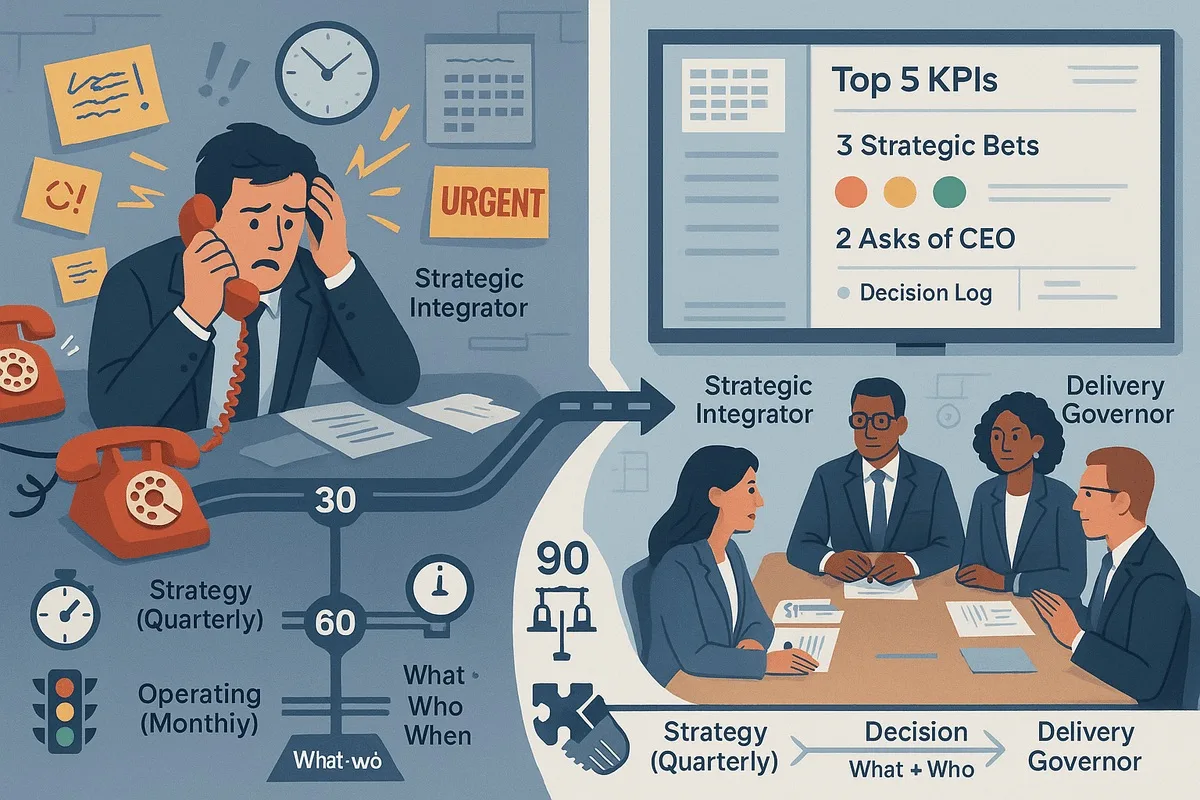
I sat across from a CEO on a Monday morning who handed me his calendar like it was a confession. Back-to-back standups. A budget fire drill bolted on at 8 a.m. A strategic bet quietly slipping from green to yellow while nobody in the room had the authority, or the agenda space, to say so out loud. My answer wasn't a bigger calendar or a better app. It was three red items on one page, and a 90-day experiment I asked him to trust me on: one monthly operating review built around his top five KPIs, one quarterly strategy forum for the decisions that actually change the business, and a hard rule that every discussion ends with "what, who, when" before anyone leaves the room. Within three weeks his emergency sessions had dropped by more than half, and he had his Thursday afternoons back for customer visits instead of status theatre.
That's the whole thesis of this piece, stated plainly: most executive calendars aren't overloaded because there's too much work; they're overloaded because there's no cadence separating a decision from a discussion from a fire. Fix the cadence and the hours reappear. I've run this exact playbook with a dozen CEOs and it works often enough that I no longer treat it as a nice idea. I treat it as the default fix.
🧭 From firefighting to focus: The case for dual cadences
Most leadership teams live in reactive mode, and I don't think that's a character flaw: it's a structural one. There's usually exactly one forum for everything: strategy, budget, personnel, crisis. Cram every kind of decision into one meeting type and you get the worst version of all of them. My fix is to run two linked rhythms instead of one blended one. First, a quarterly Strategy Forum (90 to 120 minutes) that exists only to weigh 12-to-36-month bets, resource pivots above a set dollar threshold, and scenario trade-offs. Second, a monthly Operating Review (60 to 90 minutes) that tracks the top six KPIs, dives only into items flagged red, and closes every topic with an owner and a date. I've asked CEOs to trial this as a 90-day experiment and personally run the first three Operating Reviews myself, so the CEO can watch the format work before they own it.
Why this matters now: executives spend a huge share of their week in meetings, but not the ones that create capacity. In the landmark Harvard Business School time-use study of 27 CEOs (Porter and Nohria, tracked nearly 60,000 hours and published in Harvard Business Review), CEOs worked about 62.5 hours per week and spent 72% of that time in meetings. (hbr.org)
📊 The hidden math of meetings (and why "lightweight" wins)
Meeting sprawl is costly, and it compounds quietly. Bain's research found that roughly 15% of an organization's collective time goes to meetings, and traced how a single weekly executive committee meeting at one company drove 300,000 hours a year of supporting preparation and related sessions. (bain.com)
I've watched that same ripple effect happen inside mid-market companies at a smaller scale: a weekly all-hands leadership meeting quietly spawns three pre-meetings and two recap emails, and nobody notices because each piece looks small. A dual-cadence model fixes the math by concentrating decisions where they belong instead of letting them sprawl sideways. The monthly Operating Review surfaces only management-by-exception items, for example, greater than 15% budget variance, or more than two weeks late on a top initiative. Everything else stays out, on purpose. That discipline is what gets you brevity without losing control, and it's the single hardest habit for a founder-CEO to hold onto, because their instinct is to look at everything, every time.
How I evaluate a CEO's meeting cadence
- The red-item test: If a meeting can't tell me, within the first five minutes, which items are red and why, the cadence has already failed: it's a status readout, not a decision forum.
- The ownership test: Every topic must close with a named owner and a date. If a meeting ends without both, I count it as a discussion that pretended to be a decision.
- The forum-fit test: Decide whether this topic belongs in the monthly Operating Review or the quarterly Strategy Forum. Most tactical fires get dragged into strategic time because nobody has defined the boundary: that's a design failure, not a discipline failure.
- The pre-read test: If the room is reading the material live, the forum is under-designed. A one-page pre-read sent 24-48 hours ahead is non-negotiable; without it, the meeting reverts to narration.
- The compounding test: I judge a cadence not by one good meeting but by whether the same framing, template, and one-pager survive unchanged for 90 days. Consistency, not cleverness, is what makes a cadence trustworthy to a team.
🧠 Pick a visible role, and play it every meeting
Every operator I coach into this role adopts one clear identity for the executive forum, stated in writing, and holds it for the full 90 days:
Strategic Integrator: tie market signals to resource moves and long-term KPIs.
Constructive Challenger: make assumptions explicit and push for trade-offs.
Delivery Governor: anchor on measurable commitments, R/Y/G status, and capacity.
Signal the choice in writing once, keep it for 90 days, and reinforce it live. Start each session with a 30-60 second framing that links the agenda to a decision or metric. The template is consistent: Desired decision → Options & trade-offs → Impact on KPIs/budget → Recommendation. Close each topic with "what, who, when." These are small, repeatable moves, and they're exactly what build trust fast, because a room learns quickly whether decisions actually stick after the meeting ends.
📣 Scripts that lower defenses, not morale
When a CEO is urgency-driven or wary of "process," language matters more than the framework itself. These are the exact lines I use:
Opening framing: "Today's goal is one decision on X and the top three risks we need to mitigate. I'll keep us to 60 minutes."
Trial ask: "Can we try a 90-day experiment: a monthly operating review on the top 5-6 KPIs and a quarterly strategy forum for decisions above $X? I'll run the first three. If it helps, we'll keep it."
Tactical detour redirect: "Quick check: tactical fix or strategic decision? If tactical, I'll capture the action and bring a proposed process to the operating review so we stay focused here."
These lines pair clarity with respect. I've never had a CEO push back on being asked to try something for 90 days when the ask comes with a named owner (me, at first) and a clear exit if it doesn't work. That's also what high-performing companies do more broadly: make good decisions quickly and execute them fast, without trading away quality to get there.
📨 The one-page that earns attention (and time back)
Deliver a concise dashboard 24-48 hours before the meeting. It should contain:
- Top 3 strategic bets with health (G/Y/R) and a one-line risk if they fail
- Top 3 operational risks with owners and R/Y/G
- Two asks of the CEO this month
- A snapshot of the last three decisions and status
Why pre-reads matter: Microsoft 365 users now spend roughly 60% of their time on communication: email, chat, and meetings, leaving only about 40% for creative tasks, according to Microsoft's 2025 Work Trend Index as reported by Forbes. A clean one-pager cuts directly against that ratio: it moves the reading out of the room and prevents the live session from becoming a status readout. (forbes.com)
🧩 Influence without a showdown
I always advise quiet coalition-building over confrontation: recruit one peer who benefits from discipline and one CEO staffer who shapes tone. Use the same one-pager with them, and frame every ask as help, not critique: "I need your help to protect the plan from scope churn. Will you support a gate for changes above $X?" In the room, I use a visible timer and a running "decision log" to keep momentum honest. If the CEO pivots to tactics mid-meeting, I ask whether it belongs in the operating cadence and offer to bring a fix by Friday. That question, asked calmly and consistently, is what keeps the meeting's spine intact without ever forcing a public confrontation.
📈 What "good" looks like after 90 days
- Fewer emergency/interrupt-driven meetings per month
- Higher on-time delivery for the top three initiatives
- CEO hours shifted from firefighting to strategic work
- Decision cycle time (days from proposal to decision)
- A brief peer pulse on whether meetings are more decision-focused
These outcomes track with a broader pattern I see across the leadership teams I work with: organizations that pair speed with quality in their decisions consistently outperform peers who focus on one at the expense of the other. Speed and quality aren't in tension once the forum and the facts are both clear: the tension only exists when the forum is undefined.
🛠️ A first week you can actually run
Day 1-2: Build the one-page template and send it for feedback.
Day 3: Hold three 1:1s (CEO, two allies). Position the 90-day experiment as time-savings and fewer surprises.
Day 4-5: Run a 60-minute Operating Review pilot. Discuss only red/yellow items. End each topic with "what, who, when." Start a shared decision log.
I'd add one thing I tell every operator taking this on: don't wait for permission to run the pilot well. The CEO is watching the first session more closely than any of the ones that follow; if it runs tight, on time, and produces one real decision, you've earned the next 89 days. If it runs long and vague, you've lost most of your credibility before the experiment even starts.
🔄 The habit that compounds
The smallest, most durable shift is consistency: the same framing, the same decision template, the same one-page view, every single time. Over weeks, the forum becomes the place where strategy and budget stop fighting for airtime. The CEO sees fewer surprises. Teams know which metrics matter. And the calendar starts to reflect the company's actual intent, not its accumulated emergencies.
Why I trust this playbook more than most process fixes
I've seen a lot of process interventions fail in the first month because they ask a CEO to change their behavior before they've earned any evidence that the change is worth the discomfort. This one doesn't. It asks for 90 days, it comes with someone else running the risk of the first three sessions, and it produces a visible artifact (the one-pager, the decision log) that the CEO can point to and say "this is working" or "this isn't" without having to trust anyone's opinion, including mine.
The distinction I'd want a reader to walk away with is this: most leadership teams try to fix meetings by adding structure to the meeting itself: an agenda template, a facilitator, a timer. That helps at the margins, but it doesn't address the real problem, which is that different kinds of decisions are being forced through the same forum. Separate the cadences first. The tactics (timers, templates, pre-reads) only work once decisions have somewhere correct to land.
I don't think of this as a meetings fix at all, honestly. I think of it as a decision-rights fix that happens to show up on the calendar. The CEO isn't buying back hours because the meetings got shorter. They're buying back hours because for the first time, most of what crosses their desk has already been sorted into "this is strategic" or "this is not," and only the strategic half needs them in the room.
If you're an operator sitting across from a CEO with a calendar like the one I described at the start of this piece, don't ask for a bigger meeting or a better agenda template. Ask for 90 days, three red items, and a one-page pre-read. That's the whole opening move, and in my experience, it's almost always enough to get a yes.
If you want structured support putting this into practice, join The Capability Forum.